
What Can Four Beginners Learn in 27 Hours?: Seven Factors Behind Extraordinary Team Learning
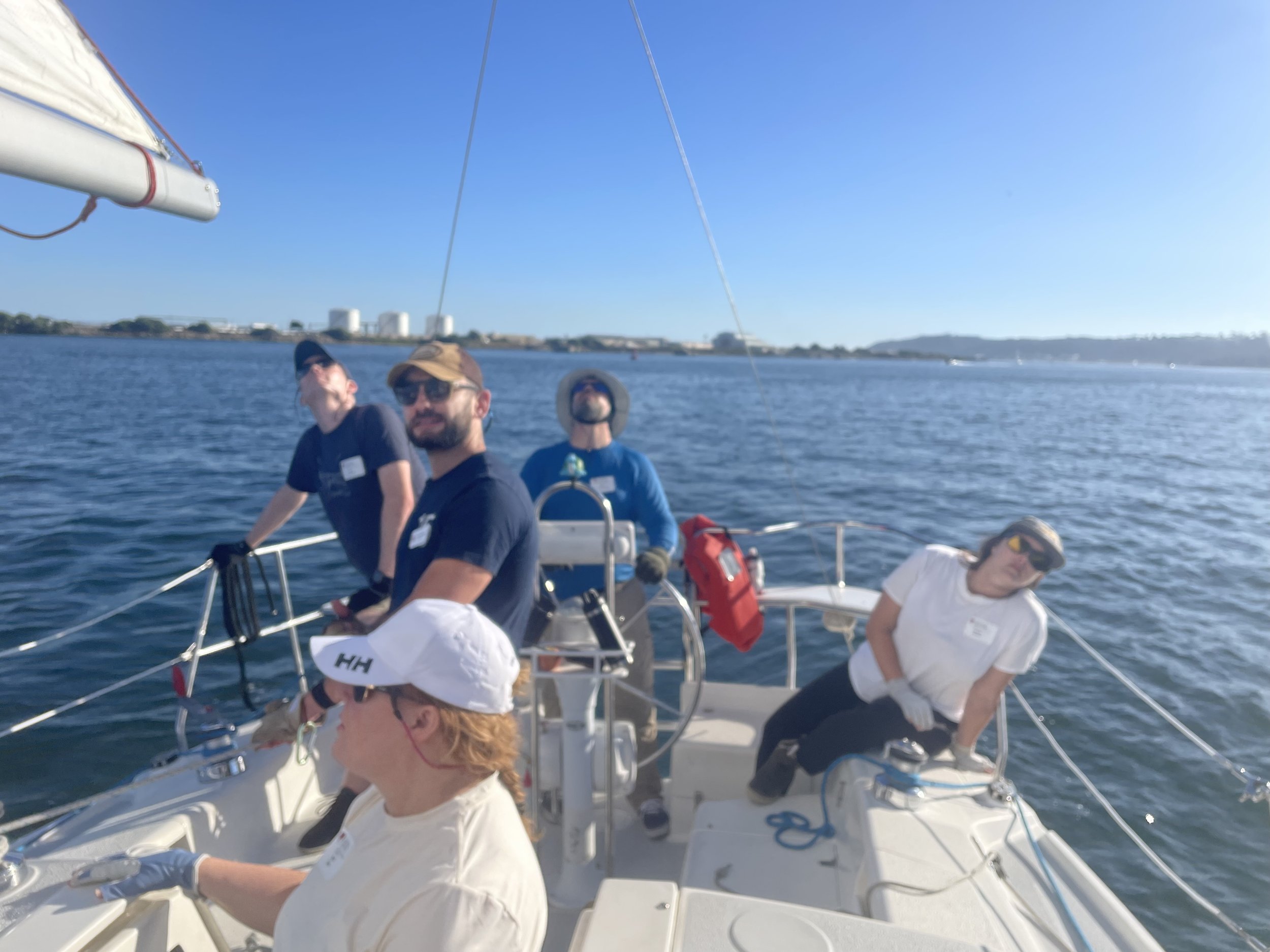
Daniels College of Business EMBA Team Sailing Challenge, October, 2023
Four Executives Step Onto a Sailboat
Four executives get on a sailboat for a three-day cruise. This could be the start of a bad joke, but it's not. It could be the start of a tabloid story in this moment in time, but it's not. It could even be the beginning of one of those corporate metaphors told at town hall meetings. Well...actually…it could be.
What it definitely is…the beginning of a story about an experiential learning program that I've been involved with for the past five years and have had the privilege of leading for the last four: the Team Sailing Challenge for the Executive MBA program at the Daniels College of Business at the University of Denver. This past April, I led the program for Cohort 85 and, once again, found myself reflecting on why this experience is so powerful.
If you sift through the blogs on my website, you'll find a post I wrote after my first trip in the fall of 2021. I had been invited by Scott McLagan and Cindi Fukami, who were leading the program at the time, and I came away fascinated by what I had witnessed. My conclusions today aren't all that different. The difference is that I've now had four additional years—and seven more sailing expeditions—to watch the same phenomenon unfold again and again. Along the way, I've had the pleasure of co-leading the course it is part of with Professors Cindi Fukami, Aimee Hamilton, and Elaine Richards, with amazing administrative and logistical leadership from Christina Dinegar and Erin Boss, and always with Lead Skipper Sarah Cavanaugh.
Before I talk about the value and learning of the Team Sailing Challenge, let me set the stage.
The event takes place over four days on San Diego Harbor during the fifth week of the Executive MBA program—either in late April or early October. The EMBA is a cohorted program, so we bring the entire class to San Diego (in my day, 11-27 students). Students are placed into teams of four or five and, over the course of three days, are taught to sail a 29-foot sloop (a single-masted sailboat) as a team.
Vocabulary is learned. Sailing techniques are taught. The physics of wind and boats gradually begins to make sense. And, almost without anyone noticing, team processes begin to emerge. By the end of the third day—actually much earlier, as I'll describe below—the teams are no longer simply sailing the boats; they are racing them by themselves.
This program has been in place for more than twenty-five years. It was created by Daniels Professor Cindi Fukami, Skipper Sarah Cavanaugh—a member of the first all-women's America's Cup team—and several others. I claim very little authorship of the program itself. I have simply been fortunate enough to help lead it and shape it further over the past several years.
The program has many possible learning objectives. Depending on whom you ask, its greatest value lies in learning about leadership, becoming a better team member, understanding different leadership and team member styles, creating a lasting cohort bond, or simply learning to sail. All of those answers are correct and legitimate, and together they make this a truly memorable learning experience.
And...for me...the mesmerizing outcome is that four (or five) complete sailing beginners come together, learn to sail as individuals, and learn to sail—and race—as a team...in 27 hours.
That's right.
Twenty-seven hours.
They land in San Diego around 10:00 Thursday morning after flying from Denver. They get organized on shore and step onto a sailboat for the first time around noon. After six hours on the water Thursday and another four on Friday morning, they jockey at the starting line of their first race around 3:00 Friday afternoon.
Not every boat wins that first race, obviously. Some perform much better than others. But none perform terribly, everyone stays safe, and every crew successfully races its own boat.
In 27 hours.
Four people—more strangers than not and almost always complete sailing beginners—learn to sail and race as a team.
On that first trip in 2021, serving as one of the coaches aboard a boat, I found myself floored by that outcome (back then, the race didn't happen until Saturday). I remember asking the students, "How did you do this? What factors or conditions made it possible? And what can you take back to your teams in the so-called 'real world'?"
There are undoubtedly many answers to those questions—and more than a few caveats. Over the years, however, I have found myself growing a list of seven observations, seven factors that contribute to this outcome. None of them is particularly new; each has been explored in one way or another in the literature on teams, leadership, learning, and adult education. What fascinates me is not the individual ideas themselves, but the way they come together on these boats.
Seven Factors Behind Extraordinary Team Learning
Permission to Be Beginners
Learning Tailored to Each Person
Commitment to a Shared Goal
Speaking the Same Language
Expert Teaching and Coaching
When Shared Routines Begin to Emerge
Practice. Feedback. Repeat.
The Team Sailing Challenge also reflects many of the principles of adult learning. Rather than learning through lectures or abstract exercises, participants engage in an authentic, immediately relevant task that requires them to draw on prior experience, direct much of their own learning, and apply new knowledge in real time. These characteristics closely align with Malcolm Knowles’s (1984) conception of andragogy, which argues that adults learn most effectively when learning is problem-centered, experiential, and immediately applicable.
Permission to Be Beginners
By placing people into a truly foreign task, everyone has to accept that they are beginners. Each individual has to acknowledge what they do not know and engage in the task of learning. Admittedly, there is some social pressure here because of the team's shared goal. At the same time, every other team member has to acknowledge that the team is full of beginners and grant one another the grace to learn, make mistakes, and improve.
I've now been physically on 21 boats over five years (out of 37 on those trips) and have come to think of them as extraordinary learning environments. Psychological safety—embodied by the freedom to make mistakes, ask questions, and learn without fear of embarrassment or repercussions—is remarkably high, and learning is remarkably fast.
Amy Edmondson's pioneering research defines psychological safety as a shared belief that the team is safe for interpersonal risk-taking. Teams with high psychological safety learn more quickly because members ask questions, admit mistakes, seek help, and experiment with new approaches without fearing embarrassment or punishment. Importantly, psychological safety is not about lowering standards or avoiding accountability; rather, it creates the conditions under which people can learn quickly enough to meet high standards (Edmondson, 1999).
What I find most compelling is that this environment seems to emerge naturally. Everyone arrives knowing that no one knows how to sail. There is no expectation of competence, no embarrassment in asking basic questions, and no penalty for making beginner's mistakes. That shared understanding appears to create permission to learn.
On rare occasions, we have students who already know how to sail and, in at least one instance, have raced competitively. Surprisingly, these individuals can struggle at first. They are accustomed to sailing with experienced crews and can become frustrated—or even begin to micromanage—their teammates. Eventually, however, one of two constructive things usually happens. Either the team appropriately defers to their expertise on sailing decisions, or these experienced sailors begin to supplement the skippers by becoming task- and skill-based coaches themselves. In either case, they eventually shift from being the most knowledgeable sailor on the boat to becoming another contributor to the team's learning.
Learning Tailored to Each Person
To make the program work—or at least work more smoothly—we ask students to learn a compact but still significant body of sailing knowledge and vocabulary before they ever arrive in San Diego. The material is delivered through videos and readings, and on the second day we administer a quiz. The quiz is not intended to evaluate mastery. Rather, it serves as a forcing mechanism to ensure that students have engaged with the material before stepping onto the boats.
Over time, however, I have learned that this preparation is necessary but far from sufficient. Most of the real learning happens on the water through repeated use of the language and skills.
Each team member also learns differently. Some like to visualize the maneuver before attempting it. Others prefer to have someone talk them through it step by step. Still others simply need to feel the helm, the jib sheet, or the winch in their hands before everything begins to click. Across a team of four or five students, we often see all of those learning preferences—and more.
David Kolb's experiential learning model suggests that adults learn most effectively by moving through a cycle of concrete experience, reflection, conceptualization, and experimentation. Individuals may naturally enter that cycle in different ways—some preferring observation, others discussion, and still others direct action—but effective learning ultimately involves engaging all parts of the cycle. On the boats, we see this repeatedly. Some students first want to watch a maneuver. Others want it explained verbally. Still others need to put their hands on the helm before the learning begins to make sense (Kolb & Kolb, 2005).
One of the things that has struck me over the years is that the strongest teams seem to recognize these differences instinctively. They accommodate one another's learning preferences and help each teammate learn in the way that works best for them as an individual before bringing everyone back together as a coordinated team.
Commitment to a Shared Goal
The task itself also creates something that I think is easy to overlook: a genuinely shared goal.
From the moment students step onto the boat, everyone understands the objective. Learn to sail well enough that, by the end of the experience, the team can safely and effectively race the boat on its own. Success is not measured individually. It is measured collectively. Either the team can sail the boat, or it cannot.
At first glance, this may seem obvious. Most organizations also have goals. Yet many organizational goals are experienced as someone else's objective—a manager's, a department's, or the organization's. They are understood intellectually but never fully owned.
The sailing challenge feels different.
The goal is immediate. It is visible. It matters to everyone on the boat. Students quickly realize that individual success is impossible without team success, and that realization changes the way they approach both learning and helping one another learn.
Research has long demonstrated the power of shared goals. Gowen (1985) found that teams pursuing both common and individual goals consistently outperformed teams focused on individual goals alone. Locke and Latham's work on goal-setting theory similarly shows that goals are most powerful when people not only understand them but internalize them—when they become personally meaningful and generate genuine commitment rather than mere compliance (Locke & Latham, 2002).
That distinction resonates with what I observe on the boats. Students are not simply trying to satisfy the instructors or complete an assignment. They begin to view the team's success as their own success. Once that shift occurs, coaching, encouragement, and feedback become natural rather than forced because everyone has a vested interest in helping every other person improve.
The result is a level of shared commitment that seems to accelerate both individual learning and team learning simultaneously.
Speaking the Same Language
One of the first things students discover is that sailing has its own language.
Very quickly they stop saying "rope" and begin saying "line." They learn the difference between the jib sheet and the mainsheet, the bow and the stern, port and starboard, tacking and jibing. At first the vocabulary feels foreign and, at times, even overwhelming. Before long, however, it becomes second nature.
On the surface, this may seem like a simple matter of terminology. In reality, something much more important is happening.
A common language allows the team to communicate precisely, coordinate quickly, and learn efficiently. As everyone adopts the same vocabulary, instructions become shorter, misunderstandings become less frequent, and the team's attention shifts from figuring out what words mean to figuring out how to sail the boat better.
This observation extends well beyond sailing. Carlile's work on knowledge transfer argues that specialized knowledge is difficult to share across individuals and groups unless people develop common ways of describing and interpreting their work. Shared language becomes one of the mechanisms through which knowledge is transferred, coordinated, and ultimately put into action (Carlile, 2002).
Watching this happen on the boats has made me appreciate just how powerful a common language can be. It doesn't simply improve communication. It accelerates learning. Once everyone begins speaking the same language, the team is able to devote far less energy to interpreting instructions and far more energy to improving performance.
Expert Teaching and Coaching
One of the obvious advantages of the Team Sailing Challenge is that students are not left to figure things out on their own. Every boat has a world class teaching skipper and an experienced team coach whose primary responsibility is to teach. They demonstrate techniques, explain concepts, answer questions, provide encouragement, and create countless opportunities for practice.
That level of expert instruction is extraordinary. For every four or five students, there are two experienced instructors devoted almost entirely to helping them learn. Most organizations simply cannot afford — or choose not to spend money on — that ratio of teachers to learners.
Yet what has fascinated me over the years is not the presence of expert instructors. It is what happens next.
As students gain confidence, the teaching gradually begins to shift. The skipper and coach remain essential, but they begin stepping back. Increasingly, students answer one another's questions, offer suggestions, remind teammates of key concepts, and coach one another through difficult maneuvers. Teaching slowly becomes distributed across the team.
By the end of the experience, much of the learning is no longer flowing exclusively from the instructors. It is flowing among teammates.
That transition is important because it fundamentally changes how learning occurs. Instead of relying exclusively on expert coaching, the team begins creating additional coaching capacity of its own. Every new insight, reminder, or correction offered by one teammate becomes another opportunity for someone else to learn.
Research on team effectiveness supports this observation. Kozlowski and Ilgen (2006) argue that effective teams develop collective capabilities through coaching, feedback, and shared learning experiences rather than relying solely on the expertise of individual members. The strongest teams become learning systems in which knowledge is continually exchanged, refined, and reinforced.
Watching this happen on the boats has changed the way I think about teaching. Expert instruction is essential at the beginning. But the real acceleration occurs when the learners themselves begin teaching one another. At that point, the team is no longer simply receiving knowledge—it is actively creating and distributing it.
When Shared Routines Begin to Emerge
As the weekend progresses, something subtle begins to happen.
Without anyone announcing it or consciously designing it, the team develops routines.
People begin anticipating one another's actions. Commands are given in familiar ways. Team members naturally fall into roles during common maneuvers. The sequence of preparing for a tack or a jibe becomes increasingly predictable. Conversations become shorter because everyone already understands what comes next.
The routines are rarely discussed, yet they become one of the team's greatest assets.
Organizational scholars Richard Nelson and Sidney Winter argued that routines are the organizational equivalent of skills. Rather than requiring people to rethink every action from first principles, routines allow groups to perform familiar tasks efficiently while directing their attention toward new challenges (Nelson & Winter, 1982).
That is exactly what I observe on the boats.
During the first few hours, nearly every maneuver requires deliberate thought and detailed instruction. By the second and third days, much of that coordination has become automatic. The team no longer has to think as much about how to work together, allowing it to devote more attention to how to sail better.
This may be one of the quietest factors in the entire experience, but I suspect it is also one of the most important. Shared routines reduce cognitive effort, improve coordination, and create space for continued learning. They become part of the team's operating system, allowing the group to tackle increasingly complex challenges without becoming overwhelmed by the basics
Practice. Feedback. Repeat.
If there is one thing the sailing challenge provides in abundance, it is repetition.
Students don't simply learn a maneuver once and move on. They tack repeatedly. They jibe repeatedly. They trim sails repeatedly. They dock, undock, hoist sails, lower sails, and perform countless other tasks again and again over the course of three days.
But repetition alone is not what makes the learning so powerful.
Every attempt is followed almost immediately by feedback.
Sometimes that feedback comes from the skipper or coach. Sometimes it comes from a teammate. Sometimes it comes from the boat itself. The sail luffs. Boatspeed slows. A maneuver feels smoother—or it doesn't. Every action produces information that students immediately use to adjust their next attempt.
That continual cycle of practice, feedback, reflection, and adjustment appears to accelerate learning dramatically.
Research on expertise consistently reaches the same conclusion. Anders Ericsson's work on deliberate practice argues that improvement comes not from repetition alone, but from repeated practice accompanied by immediate feedback and opportunities for correction. Expertise develops through cycles of focused effort, evaluation, refinement, and another attempt—not simply through accumulated experience (Ericsson et. al, 1993).
The sailing challenge creates exactly those conditions. Students practice continuously, receive immediate feedback, make adjustments, and then immediately try again. Over the course of three days, those cycles accumulate remarkably quickly.
Perhaps that is the simplest way to summarize the entire experience.
Learning happens.
Then practice.
Then feedback.
Then reflection.
Then another attempt.
And then the cycle begins again.
A Temporary Learning Organization
Individually, none of these observations is particularly surprising. Collectively, however, they began to look less like seven independent ideas and more like the interconnected conditions that create an extraordinary learning environment.
I did not set out to develop a new framework for organizational learning, nor did I begin this project intending to illustrate existing ones.
My objective was much simpler. I wanted to understand why groups of complete beginners consistently learned so much, so quickly.
Only after watching this pattern repeat itself across 37 different crews over five years was I able to truly integrate what I had been witnessing.
Reflecting on the seven factors described in this essay, I found myself thinking about a body of literature that I had not originally considered. For decades, scholars have studied organizations that learn—organizations that adapt, improve, and develop capabilities faster than their competitors. Chris Argyris and Donald Schön (1978) explored how organizations detect and correct errors. Peter Senge (1990) described the disciplines of the learning organization, emphasizing shared vision, team learning, and systems thinking. Others have examined organizational routines, knowledge creation, and dynamic capabilities.
I do not teach or facilitate the Team Sailing Challenge with these frameworks in mind. In fact, I do not know what organizational theories informed the program's original design more than twenty years ago. Yet, viewed through the lens of these scholars, I cannot help but notice how closely the experience resembles what they describe.
For 27 hours, each boat becomes a temporary learning organization. Nearly every aspect of the experience is organized around acquiring, sharing, refining, and applying knowledge…and embodying it not just in our minds, but in our bodies. Psychological safety encourages questions. Shared goals focus attention. A common language reduces ambiguity. Expert coaching accelerates learning. Shared routines emerge. Team members increasingly teach one another. Practice and immediate feedback drive continual improvement.
Whether viewed through the lens of adult learning, team effectiveness, or organizational learning, the conclusion appears to be the same: the conditions of the system make rapid learning possible.
That observation has caused me to wonder whether one of the most important questions leaders can ask is not simply, "How do I build a high-performing team?" but rather, "How do I create an environment in which my team learns unusually quickly?"
Those questions are not identical.
The sailing experience suggests that learning is not simply one contributor to high performance. Under the right conditions, rapid learning may actually be the mechanism through which high performance emerges.
Of course, I invite every reader to ask the same question I eventually began asking myself:
If these conditions produce such remarkable learning on a sailboat, what survives when we return to the realities of organizational life?
From the Sailboat to the Workplace
If this essay has accomplished anything, I hope it has convinced you that something unusual happens on these boats.
Over roughly 27 hours, four or five strangers become a functioning team while simultaneously learning a genuinely difficult new skill. Along the way, they develop psychological safety, commit to a shared goal, adopt a common language, coach one another, establish shared routines, and improve through repeated practice and immediate feedback. None of those observations is particularly surprising in isolation. What strikes me as remarkable is how quickly they occur when the conditions are intentionally designed to support learning.
The obvious question, then, is whether these observations tell us anything useful about organizations.
My answer is yes—but with an important qualification.
The Team Sailing Challenge is not a perfect simulation of organizational life. Nor was it ever intended to be. In fact, some of the very conditions that make the experience such a powerful learning laboratory are difficult—perhaps impossible—to reproduce in most workplaces. Rather than weakening the lessons, however, I think these differences help us understand more clearly what organizations are—and are not—designed to do.
Consider just a few examples.
First, we intentionally place teams of complete beginners together. Most organizations would never do that. Teams typically consist of people with widely varying levels of expertise, experience, tenure, confidence, and organizational standing. That diversity is enormously valuable because experienced members allow the team to function almost immediately while directing coaching toward those who need it most.
Yet I cannot help but wonder whether something is lost as well.
There is something uniquely liberating about a team in which everyone is equally inexperienced. No one is expected to know. No one worries about appearing less competent than everyone else. Psychological safety seems almost inevitable.
My own experience suggests that creating that same level of safety becomes more difficult as differences in expertise, status, and organizational history increase. Perhaps that is simply one of the central leadership challenges of organizational life.
And, I think it’s worth asking how we create that climate of psychological safety when we have such diversity of experience.
Second, the density of instruction in the sailing program is extraordinary. Every four or five students are supported by two experienced instructors. During those first 27 hours, the ratio of teaching to performing is unlike almost anything we encounter in organizations. High-performing athletic teams, orchestras, and military units may come close, but most workplaces cannot devote that level of coaching to everyday work.
For me, this remains one of the great puzzles of organizational development.
If coaching accelerates learning so dramatically, why do we devote so little of organizational life to it?
Third, the exercise benefits from compressed time. Teams spend nearly three continuous days together learning, practicing, reflecting, and trying again. Organizational life rarely unfolds that way. Learning is interrupted by meetings, competing priorities, email, vacations, and dozens of other demands. Interestingly, agile development and sprint methodologies capture at least some of this same advantage by creating focused periods of intense collaboration.
Perhaps there is something important about concentrated learning that extends well beyond sailing.
Finally, the stakes are different. Nobody's job, compensation, promotion, or performance evaluation depends on winning a sailboat race. On the surface, that makes the exercise seem like a simulation with relatively low consequences.
Or does it?
What is on the line is pride. Reputation. Competence. Status among peers.
Those are precisely the interpersonal risks that the literature on psychological safety suggests people care deeply about. Students do not want to appear incapable in front of their teammates any more than employees want to appear incapable in front of their colleagues. The organizational consequences are removed, but many of the interpersonal ones remain.
If that is true, perhaps it helps explain why the boats become such extraordinary learning environments.
I have no interest in arguing that organizations should become sailing schools, nor do I believe there is a simple recipe for recreating these conditions at work. Every organization operates under different constraints, pursues different objectives, and must balance learning with performance in ways our weekend on the water never has to.
What I do believe is that the seven factors described in this essay provide a useful lens through which to examine our own teams.
Where do these conditions already exist?
Which have emerged naturally, and which have been intentionally designed?
Which seem absent?
Which are possible to create, even imperfectly?
Which would make the greatest difference if they did?
Ultimately, those are questions each leader must answer for themselves.
One final observation:
Every year I watch groups of complete beginners—people who have never met, know virtually nothing about sailing, and often begin the weekend wondering whether they belong on a boat at all—become capable, confident, coordinated teams in just 27 hours.
That transformation reminds me that human beings are capable of learning far more quickly than we often imagine when the conditions are right.
If these students can accomplish that in twenty-seven hours, what might be possible for your team? For your organization?
As always, I invite you to stay in conversation on this.
And, for another lens on the Team Sailing Challenge, I invite you to check out this piece that the Daniels newsroom wrote some years ago after embedding a “reporter” in our program: https://daniels.du.edu/blog/raising-the-sails-daniels-executive-mba/
And, check out my first blog on this from the fall of 2021: https://www.augustthirdleadership.com/insights/leadership-and-sailing
References
Aksoy, C. G., Barrero, J. M., Bloom, N., Davis, S. J., Dolls, M., & Zarate, P. (2023). Working from home around the world. AEA Papers and Proceedings, 113, 69–74. https://doi.org/10.1257/pandp.20231013
Allen, T. D., Golden, T. D., & Shockley, K. M. (2021). How effective is telecommuting? Assessing the status of our scientific findings. Psychological Science in the Public Interest, 22(2), 40–68. https://doi.org/10.1177/15291006211007264
Bloom, N., Liang, J., Roberts, J., & Ying, Z. J. (2015). Does working from home work? Evidence from a Chinese experiment. Quarterly Journal of Economics, 130(1), 165–218. https://doi.org/10.1093/qje/qju032
Blavo, C., Aleman, M., & Boudreau, J. (2023). Managing talent in hybrid work systems. MIT Sloan Management Review.
Bloom, N., Han, R., & Liang, J. (2024). Hybrid working from home improves retention without damaging performance. Nature, 630, 920–925. https://doi.org/10.1038/s41586-024-07500-2
Cappelli, P., & Nehmeh, R. (2025). Hybrid still isn’t working. Harvard Business Review. https://hbr.org
Choudhury, P., Foroughi, C., & Larson, B. Z. (2021). Work-from-anywhere: The productivity effects of geographic flexibility. Strategic Management Journal, 42(4), 655–683. https://doi.org/10.1002/smj.3251
Haas, M. R. (2022). 5 challenges of hybrid work—and how to overcome them. Harvard Business Review. https://hbr.org/2022/02/5-challenges-of-hybrid-work-and-how-to-overcome-them
Heng, C. S., & Chua, R. Y. J. (2024). Stuck at home: Does the virtual office stifle creativity? California Management Review, 66(2), 84–104.
Lin, Y., Wu, L., & Evans, J. A. (2023). Remote collaboration and the decline of novel ideas. Nature Human Behaviour, 7, 123–131.
Möller, S., Deci, E. L., & Ryan, R. M. (2024). Location-based bias and remote work: Implications for employee visibility and promotion outcomes. Organization Science. Advance online publication.
Mongey, S., Pilossoph, L., & Weinberg, A. (2021). Which workers bear the burden of social distancing? Journal of Economic Inequality, 19(3), 509–526. https://doi.org/10.1007/s10888-021-09487-6
Mortensen, M., & Haas, M. (2021). Making the hybrid workplace fair. Harvard Business Review. https://hbr.org/2021/02/making-the-hybrid-workplace-fair
O’Hare, D., Parker, S. K., & Andrei, D. M. (2024). Workplace loneliness and employee well-being in remote work settings. Journal of Occupational Health Psychology, 29(1), 1–15.
Subel, S., Ko, M., & Stachowski, A. (2022). How shifts in remote behavior affect employee well-being. MIT Sloan Management Review. https://sloanreview.mit.edu/article/how-shifts-in-remote-behavior-affect-employee-well-being/
Yang, L., Holtz, D., Jaffe, S., et al. (2022). The effects of remote work on collaboration among information workers. Nature Human Behaviour, 6, 43–54. https://doi.org/10.1038/s41562-021-01196-4