
Both/And Thinking and the Work of Leading Through Persistent Tension
Given my background — roughly 20 years in business as a practicing executive and analyst, followed by 20 years in academia as a professor and researcher — it probably won’t surprise you that I’m consistently drawn to work by rigorous researchers who take their ideas seriously and make them usable for leaders. Think of Adam Grant in Give and Take or Amy Edmondson in The Fearless Organization: decades of careful research, translated thoughtfully for people who actually have consequential decisions to make. I value this work precisely because it combines accessibility with a very high bar for evidence.
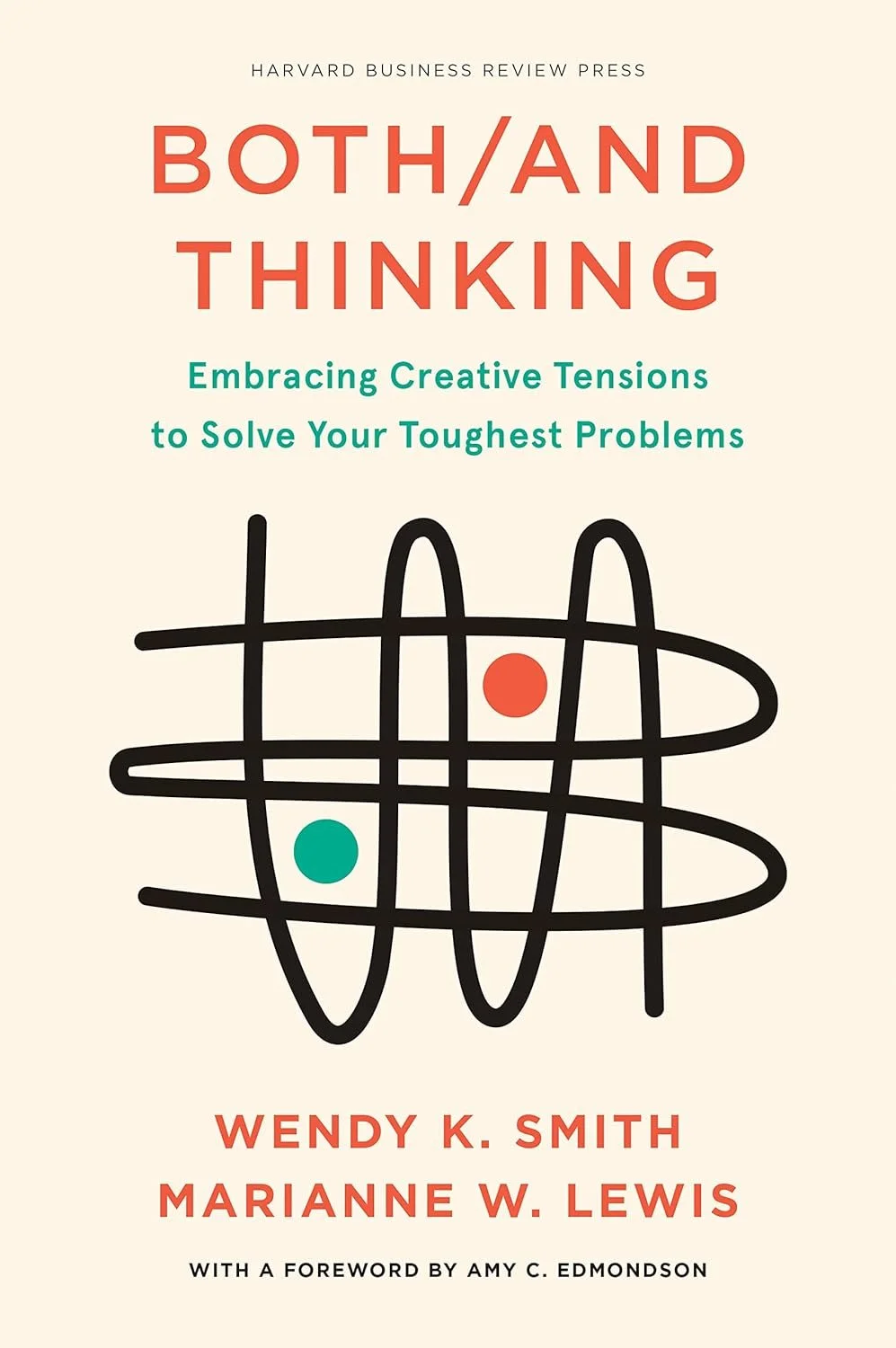
This past year, the book that stood out most clearly to me in that tradition was Both/And Thinking, by Wendy Smith and Marianne Lewis. The book was published in 2022, though I only got around to reading it more recently — a reminder that good ideas have a way of finding us when we’re ready for them. Together, Smith and Lewis bring roughly four decades of research on leadership, strategy, and organizational tension into a book that feels deeply practical — not because it simplifies leadership, but because it gives language to something leaders already experience every day.
At the heart of the book is a precise definition of paradox. Smith and Lewis define paradox as “contradictory yet interdependent elements that exist simultaneously and persist over time.” That final phrase matters. A paradox isn’t a one-time trade-off. It isn’t a decision you make and move past. It’s a collision of values, priorities, or beliefs that keeps resurfacing, creating ongoing tension.
The authors acknowledge — accurately, in my experience — that the word paradox can sound academic or abstract. Leaders are more likely to talk about trade-offs, competing priorities, or tough calls. But what Smith and Lewis are pointing to is different. Paradox is what happens when those tensions don’t go away, even after you decide. Growth versus efficiency. Short-term performance versus long-term investment. Empowerment versus accountability. Autonomy versus alignment.
These tensions persist. And because they persist, leaders need a different way of engaging them.
One of the most powerful ideas in the book — and one I’ve found immediately useful — is that progress often comes from changing the question before changing the decision. When leaders frame choices as either/or, they collapse complexity too quickly. When they ask a both/and question, they reopen the field of possibility.
Instead of asking, “Which one do we choose?” the question becomes: What would it look like to take both seriously? What becomes possible if we try to hold both at the same time?
This is not pollyannaish. Asking the both/and question does not mean you will do everything. But if you don’t ask it, you almost certainly leave value on the table.
Smith and Lewis offer two metaphors that I’ve found especially helpful for making this tangible: the mule and the tightrope walker.
The mule makes progress by integrating opposing forces — pulling them together into a new, workable path. The tightrope walker, by contrast, survives by constant adjustment, never leaning so far in one direction that balance is lost. Both are legitimate responses to paradox, but they apply in different situations.
I saw a beautiful example of the mule approach in my teaching. While leading Executive MBA students through long-term personal and professional development planning, I introduced the both/and question midway through the process. One student said, almost sheepishly, “I want to exercise more, and I want to spend more time with my son before he joins the military.” Framed as an either/or, something would have to give. Framed as a both/and, the solution emerged quickly: they started exercising together. The insight felt obvious in hindsight — and that’s precisely the point. The paradox dissolved through integration.
In contrast, many of the leaders I work with are tightrope walkers.
One CEO of a 100–200 person company felt perpetually resource constrained — a feeling most growth-stage leaders will recognize. The organization lived in constant tension between stabilizing and improving existing processes and pushing forward with new product development and new customer acquisition. Both were essential. Both competed for time, attention, and capital. Rather than collapsing the tension into a single priority, the leadership team embraced a both/and frame. They structured their two most senior executives around these distinct paths — one focused on the core business, the other on growth — while intentionally maintaining frequent communication and integration points. The goal was not separation for its own sake, but balance: moving forward without drifting into two incompatible futures.
In another case, a consumer internet company’s senior leadership team was split on growth strategy. One executive favored deepening existing customer relationships; another argued for expanding into new ones. Strategically, neither was wrong. In a world of unlimited resources, both approaches made sense. The both/and question changed the conversation. With closer inspection, the team realized one path could be explored with minimal incremental resources but significant senior attention. The two leaders aligned themselves with the avenues that best matched their strategic convictions and are now pursuing both — deliberately, unevenly, but intentionally. It is still early, but the organization has clearly moved from either/or to both/and.
I see the same dynamic in leadership agility. Many leaders rely on well-validated style and personality frameworks — tools I use myself — but those frameworks can quietly harden into identity: “That’s just not my style.” In one case I’ve written about elsewhere, a leader who was deeply people-oriented needed to add a more task- and vision-focused approach. Through a both/and lens, the work shifted from abandoning authenticity to expanding capacity. The leader didn’t replace their natural style; they added to it. The result was greater effectiveness across a wider range of situations.
Across these examples — personal, strategic, and behavioral — the throughline is the same. Both/and thinking reframes the work of leadership. It acknowledges that some tensions persist, that they generate discomfort, and that the goal is not to eliminate that discomfort but to put it to productive use. The work begins by asking better questions before rushing toward cleaner answers.
My hope, in sharing these reflections, is simple. First, that you begin noticing the persistent tensions in your own leadership and organization — the ones that don’t resolve, no matter how many decisions you make. Second, that you experiment with changing the question before changing the decision. And third, that you engage deeply with work like Smith and Lewis’s: research-grounded, experience-tested, and written for leaders who live inside complexity every day.
As always, I invite you to stay in conversation on this.