
Getting Started on AI: What I learned from Ethan Mollick’s Co-Intelligence
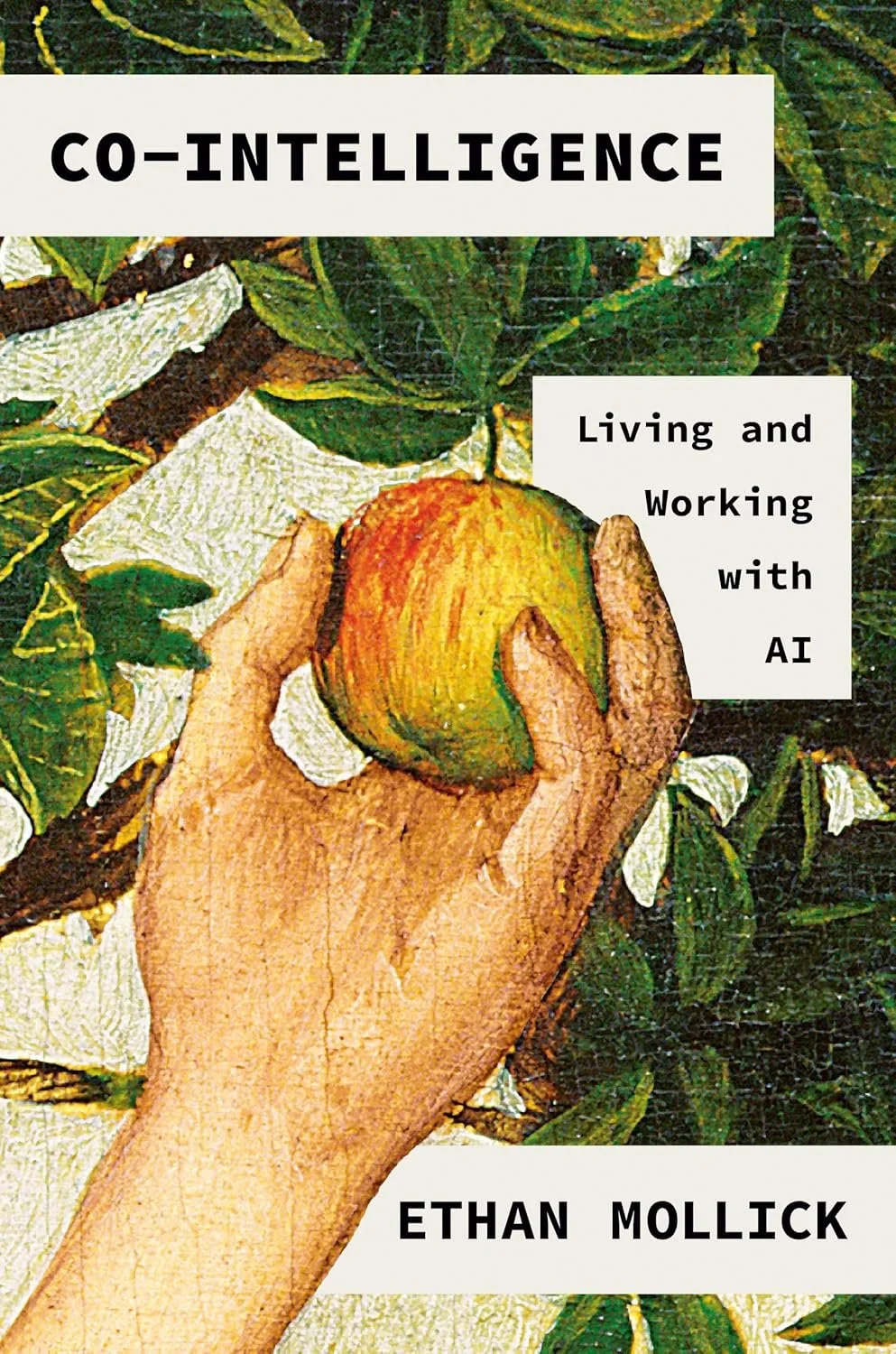
I’ll admit it: a few months ago, I realized I was behind when it came to artificial intelligence.
Or perhaps, more honestly, I had known that for a while but hadn’t done anything about it. Like many people who have built careers in teaching, leading, or coaching, I had been watching the rapid evolution of AI from a distance—intrigued, but not integrated. And to be clear, I really mean generative AI here. Machine learning and other earlier forms of AI have shaped work for years…and I’m behind on those as well.
At a high level, I understood the implications: AI would shape my coaching, my teaching, my writing, and the broader landscape of leadership and organizational life. Questions kept circulating—persistent and a little haunting:
How do I make use of generative AI in my coaching and teaching? What does it offer in terms of productivity, creativity, and accuracy?
How do I help leaders understand what AI can do for their own effectiveness?
How do I help leaders think about the organizational opportunities—and risks—associated with generative AI?
How will AI reshape tasks, roles, jobs, and organizational structures?
How do I help students—undergraduates through PhDs—use the technology in ways that actually support learning?
And in all of this…what ethical issues should we be wrestling with?
And I am sure I’m missing a few.
But even with that awareness, I still hesitated. I had played with ChatGPT here and there, but hadn’t committed to learning it in any real way.
Then a conversation nudged me forward.
A colleague, Michael Housman—someone I didn’t know well, but who clearly lived and breathed AI adoption inside organizations—gave me a direct answer when I asked, “Who should I read?” Without hesitation: “Ethan Mollick. Follow him on LinkedIn. And read his book, Co-Intelligence: Living and Working with AI.” A few days later, another trusted source posted about the book on LinkedIn. That was enough of a signal for me.
Mollick is not another self-proclaimed futurist. He’s a professor at the Wharton School at the University of Pennsylvania, where he studies innovation and entrepreneurship. His work sits at the intersection of technology, management, and human creativity. Over the past several years, he has become one of the most trusted voices helping leaders, educators, and organizations learn how to work with AI—not around or against it. His Substack, One Useful Thing, and his prolific LinkedIn presence make him a kind of public academic translating emerging AI capabilities into real-world guidance.
So I followed him on LinkedIn and was immediately both impressed and overwhelmed. He posts often—sometimes multiple times a day—and his range is enormous: new capabilities, underlying use statistics, productivity and creativity experiments, early results from research projects, and thought-provoking reflections on what might come next. It’s a lot. But for me, he’s become a go-to source.
And so I bought Co-Intelligence and dove in.
A note: The book was published in April 2024, which means it was written mostly in 2023. One colleague warned me it was already a little dated. That’s not wrong. But I still found it immensely useful, and I share my reflections here.
What Stood Out
Four ideas stayed with me—not necessarily while reading, but as I lived with the book over a few days.
1. AI as a partner
Mollick’s central argument is simple and profound: the best way to learn AI is to use it—constantly, curiously, and creatively. Treat AI as a partner, not a tool or a fad. Push its limits. Stretch your own thinking. Experiment daily.
That mindset alone changed my thinking. I’m doing that right now while writing this post.
(Transparency note: I asked ChatGPT to interview me about the book to surface my own takeaways. I then asked it to produce a draft blog using my stored voice template. From there, I edited heavily—adding content, removing redundancies, and refining voice. This is, more or less, how I approach most writing: generate, reflect, revise. AI simply sped up the “generate” part here.)
2. The “thousand professions” analysis
Mollick (with AI’s help) analyzed about 1,000 professions to estimate how much each might be affected by AI. Affected is the key word—not necessarily replaced. He frames AI as an integrating force, not a purely substitutive one.
Still, seeing “business school professor” ranked 22nd was humbling. I had two immediate reactions:
- A flicker of anxiety: “Am I at risk?”
- A surge of opportunity: “If this is true, I need to be on the leading edge of this shift.”
At the time, I was mid-term in my teaching and couldn’t (or chose not to) change much immediately. But I have a break now, and it’s become a moment to set goals: how to use AI for my own productivity and creativity, how to help students use it to learn, and how to help them understand how AI will reshape the very topics we study together.
3. Accuracy vs. creativity
Mollick distinguishes—and demonstrates—the difference. Generative AI shines at idea generation: it ranges widely, surfaces unexpected angles, and expands the possibility space. It’s a super brainstorming tool. And, as we know, perfect accuracy isn’t the goal in brainstorming.
But with bounded, academic tasks—such as research—AI can hallucinate (seemingly the technical term) in ways that feel plausible but are fabricated. That contrast has reshaped how I think about where AI adds value and where human judgment must firmly stay in the loop.
4. The four futures
Mollick closes the book with four scenarios for humanity’s relationship with AI—from modest impact to machine-dominant worlds. It’s serious, honest, and sobering. He doesn’t pretend to know which future is coming. That humility is part of what makes him credible. The book ends with an invitation to keep learning.
It’s hard to argue with that.
Integrating the Ideas
My biggest takeaway is that leaders—and all of us—must develop a partnership mindset with AI. Not as a replacement for human thought partners but as an addition. AI is especially good at generating possibilities, patterns, and connections we might not see. That resonates with my work in leadership and coaching, where broad thinking and integrative decision-making matter.
In that sense, AI has become an “ally in learning.” Leadership is, at its core, a learning act: curiosity, experimentation, humility. AI accelerates that if we let it.
The Emotional Challenge
Mollick’s ranking of “affected professions” landed hard. It made me reflect on what it means to adapt when much of your identity was built before AI existed. For those of us in our 50s or 60s, this may be one of the most personal change-management exercises of our careers.
When spreadsheets emerged in the late ’80s, I was new to the workforce and dove in eagerly. But I wasn’t trying to unlearn decades of prior methods. This is different.
There’s fear—of being replaced, of not “getting it,” of being too late to catch up. But like any major change, the only way through is forward. Mollick’s point is not that AI will make us obsolete, but that our value will increasingly depend on whether we learn to work with it.
Daily experimentation isn’t a mandate; it’s a path to staying vital.
Learning on steroids
We know that leadership – but really any role – is fundamentally about learning. About leaning into the new, uncertain, uncomfortable terrain in pursuit of growing and developing ourselves our teams. That mandate has never been more clear to me than right now. We all need to embrace the opportunity to learn, while recognizing the discomfort that comes with it. As leaders, our job is to create an environment that motivates learning even in – actually, particularly in – the moments of discomfort. (More on this at a later date).
And, let me note, that we can and must learn from everyone. Since reading the book, I’ve also noticed how much more attuned I am to AI-related conversations and opportunities. One of my former EMBA students, Ben Eicholz, has been especially influential in pushing my thinking in just a few short interactions.
Changing My Own Practice
Since reading Co-Intelligence, I’ve made or begun real shifts.
In my teaching, I’m revisiting the possibility of the flipped-classroom model. Students absorb content—readings, lectures, frameworks—on their own, often with AI-supported summaries or explanations. Then class time becomes experiential: discussion, coaching, synthesis. AI becomes part of learning outside the classroom so we can use our shared time for what only humans can do (so far).
In my coaching, AI has become a behind-the-scenes thought partner. When exploring strategy pivots or communication challenges with clients, I often use AI to expand the landscape of possible approaches. Not to get answers, but to generate better questions.
In my writing, I’ve adopted one of Mollick’s simplest recommendations: do something with AI every day. That habit keeps me learning, experimenting, and noticing my assumptions.
And in my personal life, AI has been unexpectedly helpful. My fiancé (who by the likekly time you read this will by my wife) and I used it to research wedding venues, find a rabbi, and build early versions of our playlists—though it did recommend one song she absolutely hated, which was a good reminder that humans still have the final say.
Why It’s Worth Your Time
If a client, student, or colleague asked whether they should read Co-Intelligence, I would say yes. Unequivocally. It’s short, accessible, grounded, and deeply practical. Mollick writes like someone who understands his audience: busy, thoughtful professionals navigating uncertainty.
Yes, parts of it are already dated. AI moves that fast. But that’s part of the lesson. Waiting until things “settle down” is not a viable strategy. The best time to start learning is now. (This has raised an interesting question for me about the academic peer-review publishing process which seems to me to be too slow to adequately comment on AI).
Final Reflection
What I appreciated most about Co-Intelligence wasn’t just the content, but the stance: curiosity, empiricism, humility. Mollick models the mindset he invites us to adopt.
Reading this book reminded me that leadership today is not only about inspiring others—it’s about learning publicly, adapting visibly, and integrating new tools with integrity. For me, that means treating AI as a daily companion in teaching, coaching, and creating. Others may find a different path. But for all of us, the question is similar:
How will we cultivate our own co-intelligence?
What’s Next?
If we look back at my original questions, the biggest shift is this: I’m activated. I’m learning. And I’ll be disappointed if this is the last time I write about AI.
Stay tuned…and let me know what you think…or how we can help each other’s learning!